
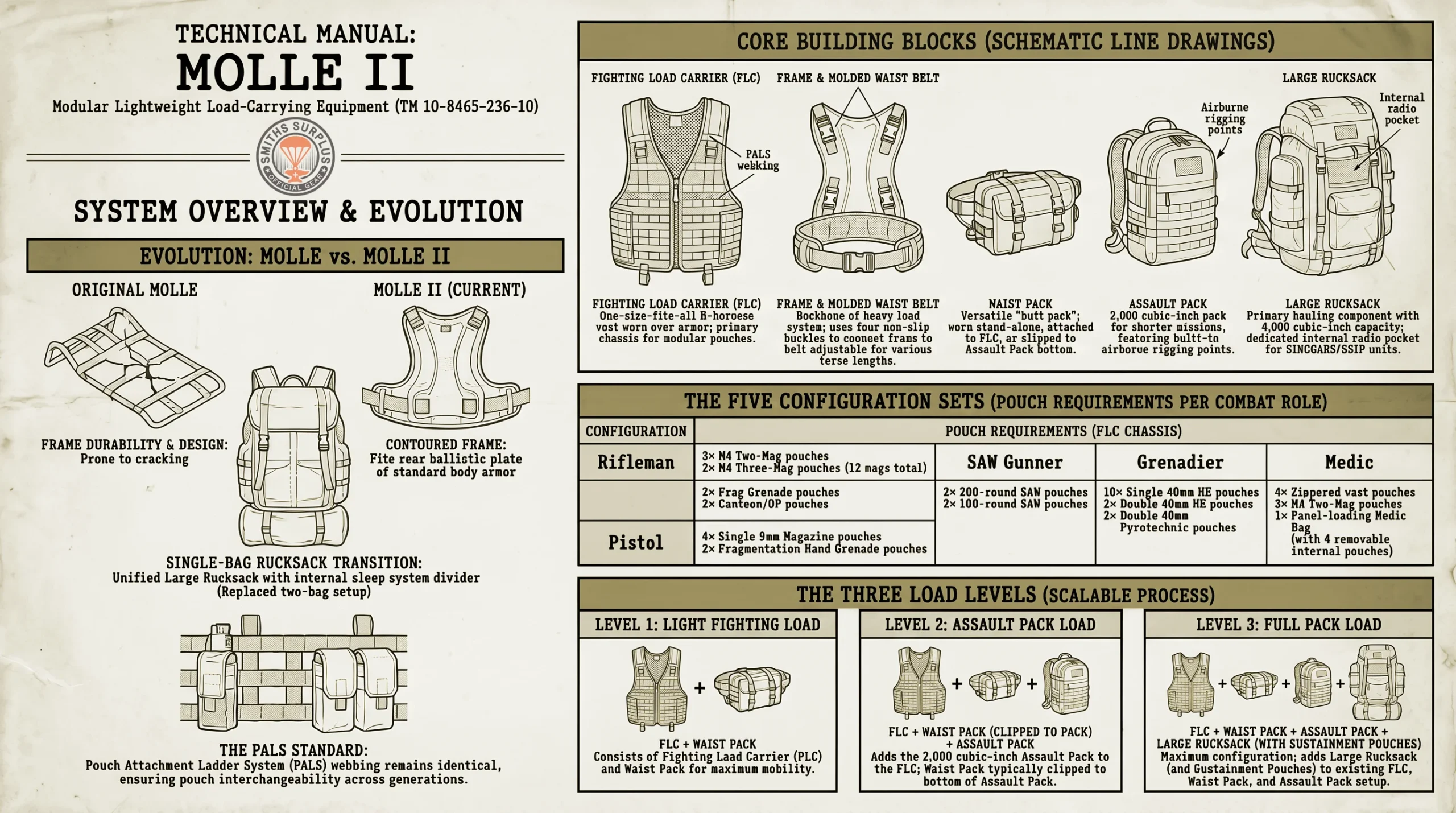
If you’ve bought a MOLLE II FLC vest, a rucksack, or a handful of pouches separately, you’ve probably wondered how they’re supposed to go together. The Army didn’t design MOLLE II as a single product, it’s a kit of interchangeable parts, built around six configuration sets and three load levels, all spelled out in the official operator’s manual.
This guide breaks down exactly how MOLLE II is built, what each configuration set is actually for, and, since the terms get thrown around loosely in the surplus market, what separates real MOLLE II from gear that’s simply MOLLE-compatible.
What Is MOLLE II?
MOLLE II (Modular Lightweight Load-Carrying Equipment) is the Army’s modular load-bearing system, documented in TM 10-8465-236-10. It replaced the All-Purpose Lightweight Individual Carrying Equipment (ALICE) system and the Integrated Individual Fighting System, including the Enhanced Tactical Load-Bearing Vest (ETLBV).
The core idea: instead of one fixed pack and vest, soldiers build a load out of separate components, a Fighting Load Carrier (FLC), a frame and waist belt, a waist pack, an assault pack, and a rucksack, then add mission-specific pouches on top. Pull what you don’t need. Add what you do.
MOLLE vs. MOLLE II: What Actually Changed
This trips up a lot of surplus buyers, so let’s clear it up.
The original MOLLE system was fielded in 1997 as the Army’s first replacement for ALICE. It introduced PALS (Pouch Attachment Ladder System) webbing, the rows of stitched nylon ladder webbing that let pouches lock onto the vest and pack. That attachment concept never changed. It’s the reason MOLLE pouches, MOLLE II pouches, and even a lot of civilian tactical gear can all mount to the same webbing today.
What changed was the hardware around it. The original MOLLE rucksack used a two-bag setup, a main pack plus a separate sleep-system carrier, and its frame attachment was a known weak point, with frames prone to cracking under hard use. MOLLE II addressed both: a revised frame, and a Large Rucksack built as a single bag with an internal sleeping-bag divider instead of two separate bags.
That’s the practical difference for a buyer: PALS webbing means pouches are largely interchangeable across generations, but the FLC vest, frame, and rucksack body are not the same parts. A MOLLE pouch will mount fine on a MOLLE II vest. A MOLLE rucksack frame will not bolt onto a MOLLE II ruck.
It’s also worth separating MOLLE II from gear that’s simply MOLLE-compatible. The MOLLE 4000 Airborne Ruck, for example, shares the same PALS attachment system and a similar 4,000 cubic-inch capacity, but it isn’t a MOLLE II component. The same goes for Marine Corps ILBE packs, like the APB03: ILBE is its own system entirely, built around the same webbing standard. Compatible webbing doesn’t mean compatible system. If you’re buying to match an issued MOLLE II configuration piece for piece, check the listing for “MOLLE II” specifically, not just “MOLLE.”
The Building Blocks of the MOLLE II System
Every MOLLE II configuration is built from the same core components:
- Fighting Load Carrier (FLC). A one-size-fits-all vest worn over body armor, with 3½-inch shoulder straps and an H-harness back panel to cut down on heat buildup. With a full set of Rifleman pouches attached, it weighs about 4 lbs.
- Frame and molded waist belt. The frame is contoured to fit the rear ballistic plate of standard body armor and attaches to the waist belt with four non-slip buckles. Both adjust for shorter torsos.
- Waist pack. A multi-purpose pack that can be worn three ways: clipped to the bottom of the Assault Pack, attached directly to the back of the FLC, or carried stand-alone on its own 2-inch waistbelt. See all three in detail →
- Assault pack. A 2,000 cubic-inch pack with airborne rigging points built in. Adding the Ruck Sustainment Pouches to its sides bumps capacity by another 1,000 cubic inches. Shop the 3-Day Assault Pack in M81 Woodland, Multicam, ACU or DCU Desert.
- Large rucksack. The big one, 4,000 cubic inches on its own, plus two 500 cubic-inch Sustainment Pouches on the sides. Empty, with frame and straps, it runs about 8 lbs.
- Pouches. Magazine pouches, grenade pouches, canteen/general purpose pouches, sustainment pouches, and a dedicated radio pocket inside the Large Ruck for SINCGARS/ASIP radios, all attach using the same interlocking PALS weave.
The Five MOLLE II Configuration Sets
The FLC is common to every soldier. What changes is which pouches get attached to it, based on role:
| Configuration | Pouches |
|---|---|
| Rifleman | 3× M4 Two-Magazine pouches + 2× M4 Three-Magazine Side-by-Side pouches (up to 12 mags total), 2× Fragmentation Hand Grenade pouches, 2× Canteen/GP pouches |
| Pistol | 4× single 9mm magazine pouches, 2× Fragmentation Hand Grenade pouches |
| SAW Gunner | 2× 200-round SAW pouches, 2× 100-round SAW pouches |
| Grenadier | 10× single 40mm HE grenade pouches, 2× double 40mm HE pouches, 2× double 40mm pyrotechnic pouches |
| Medic | 4× zippered medical pouches on the vest, 3× M4 Two-Magazine pouches, plus a separate panel-loading medic bag with 4 more removable medical pouches |
Swap the pouches and the same FLC chassis covers every role on the squad.
Three Load Levels
Beyond role-specific pouches, MOLLE II scales up by how much you’re carrying:
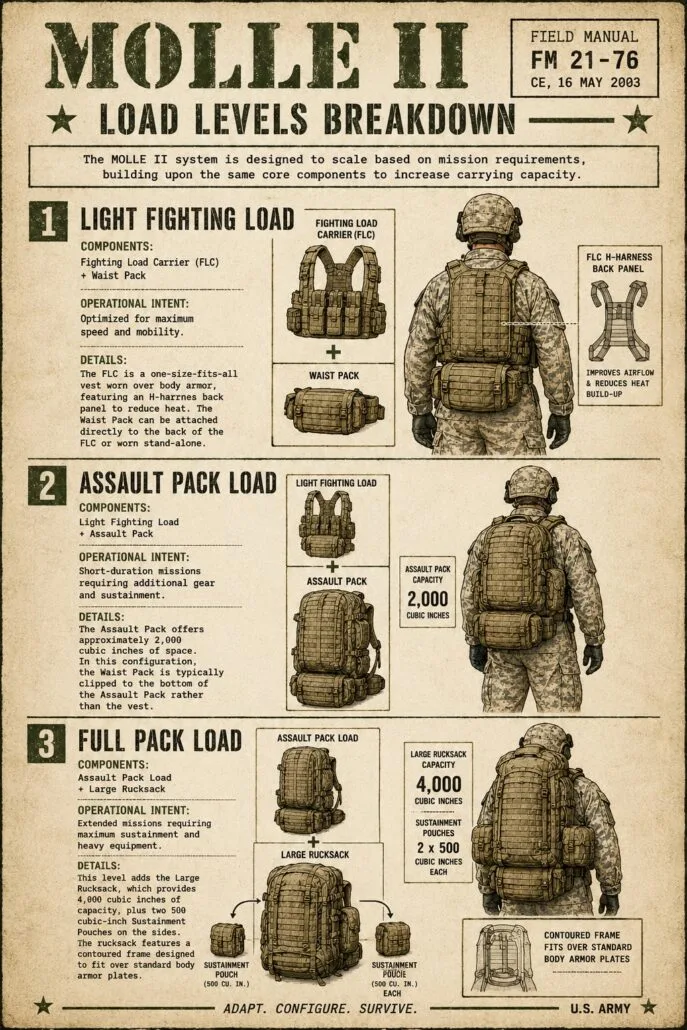
- Light Fighting Load, FLC + Waist Pack. Built for moving fast.
- Assault Pack Load, FLC + Waist Pack + Assault Pack. The Waist Pack clips to the bottom of the Assault Pack.
- Full Pack Load, FLC + Waist Pack + Assault Pack + Large Ruck. Everything you need for an extended mission.
Each level just adds the next component, nothing about the FLC or pouch setup changes.
Buying MOLLE II Surplus: What to Expect
MOLLE II was issued for years across multiple camo patterns, so condition varies piece to piece. A Good-condition FLC vest and a Good-condition rucksack won’t show identical wear, a vest sees abrasion at the shoulders and webbing, a ruck sees more wear at the frame and bottom panel. At Smiths Surplus, every piece is graded individually (New, Premium, Very Good, Good, Fair) so you know what you’re getting before it ships, not after.
Shop the MOLLE II System
Now that you know how the pieces fit together, here’s where to find them: Shop the MOLLE II System, FLC vests, frames, rucksacks, assault packs, waist packs, and configuration-specific pouches in one place.
If you’re not sure which configuration matches your old CIF issue, start with the FLC and build outward, frame and waist belt, then pouches for your role, then your load level.
Field Takeaway
MOLLE II isn’t one product. It’s a system of interchangeable pieces, and once you know the six sets and three load levels, building or replacing a configuration is just a matter of picking the right parts, not guessing.